Abstract
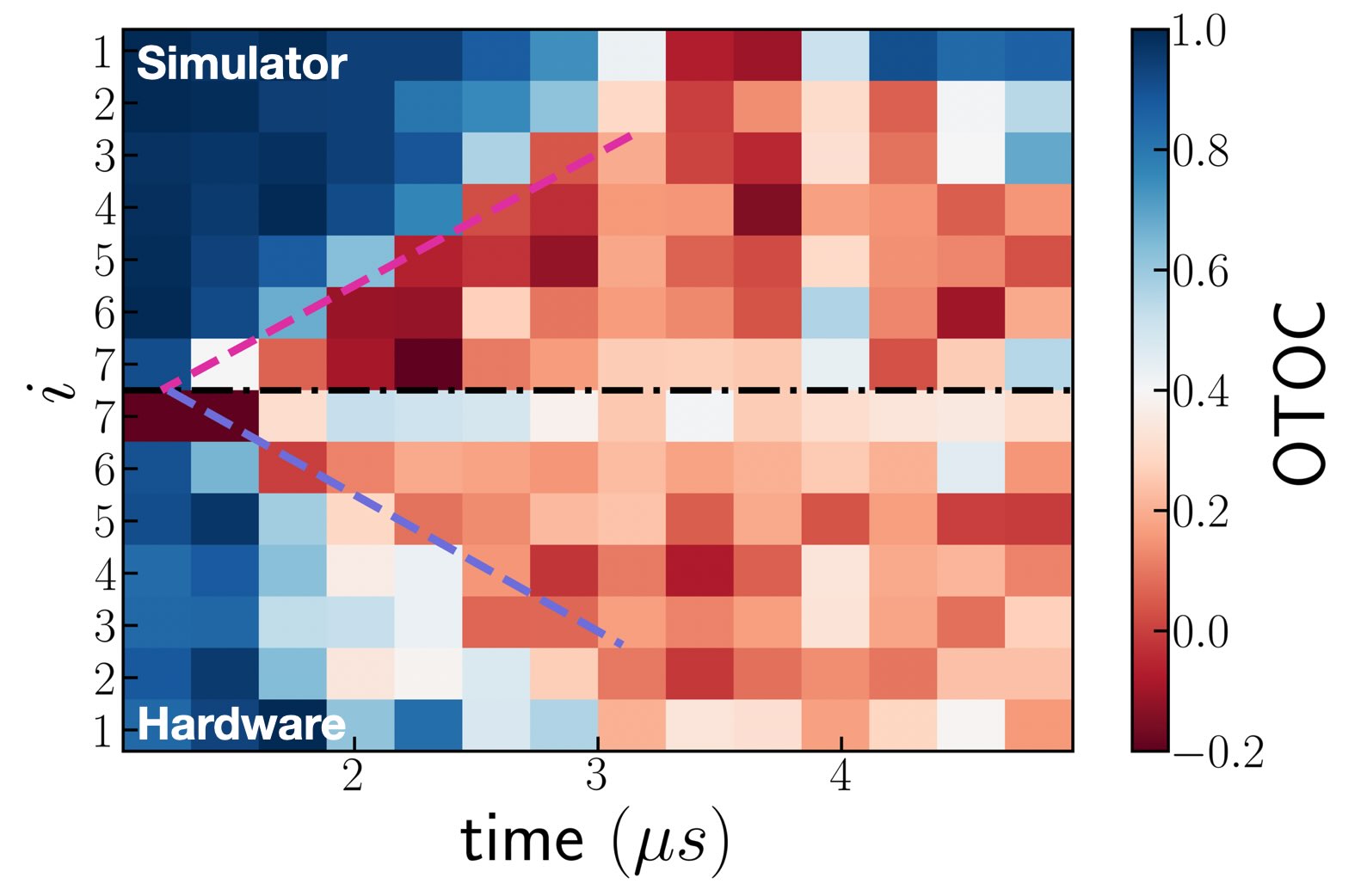
Out-of-time-order correlators (OTOCs) are the main tool for probing quantum chaos and scrambling, and have become crucial probes in many areas of quantum computing. However, the measurement of OTOCs is difficult to implement on analog quantum computers due to the requirement of backward time evolution. In this paper, we develop and implement a randomized measurement protocol to compute OTOCs on Aquila by QuEra Computing. Unlike traditional methods that require backward time evolution, our approach utilizes a sequence of global randomized quenches that approximates the unitary 2-design properties necessary for extracting infinite-temperature OTOCs from statistical correlations. We demonstrate the protocol’s success by explicitly observing the lightcone of information propagation in 1D Rydberg chains, and compare hardware results to both state-vector simulations and matrix product state (MPS) tensor network calculations. This work establishes the first demonstration of fully analog randomized OTOC measurements in neutral-atom simulators, providing a scalable pathway to probe quantum chaos in complex many-body systems.