Abstract
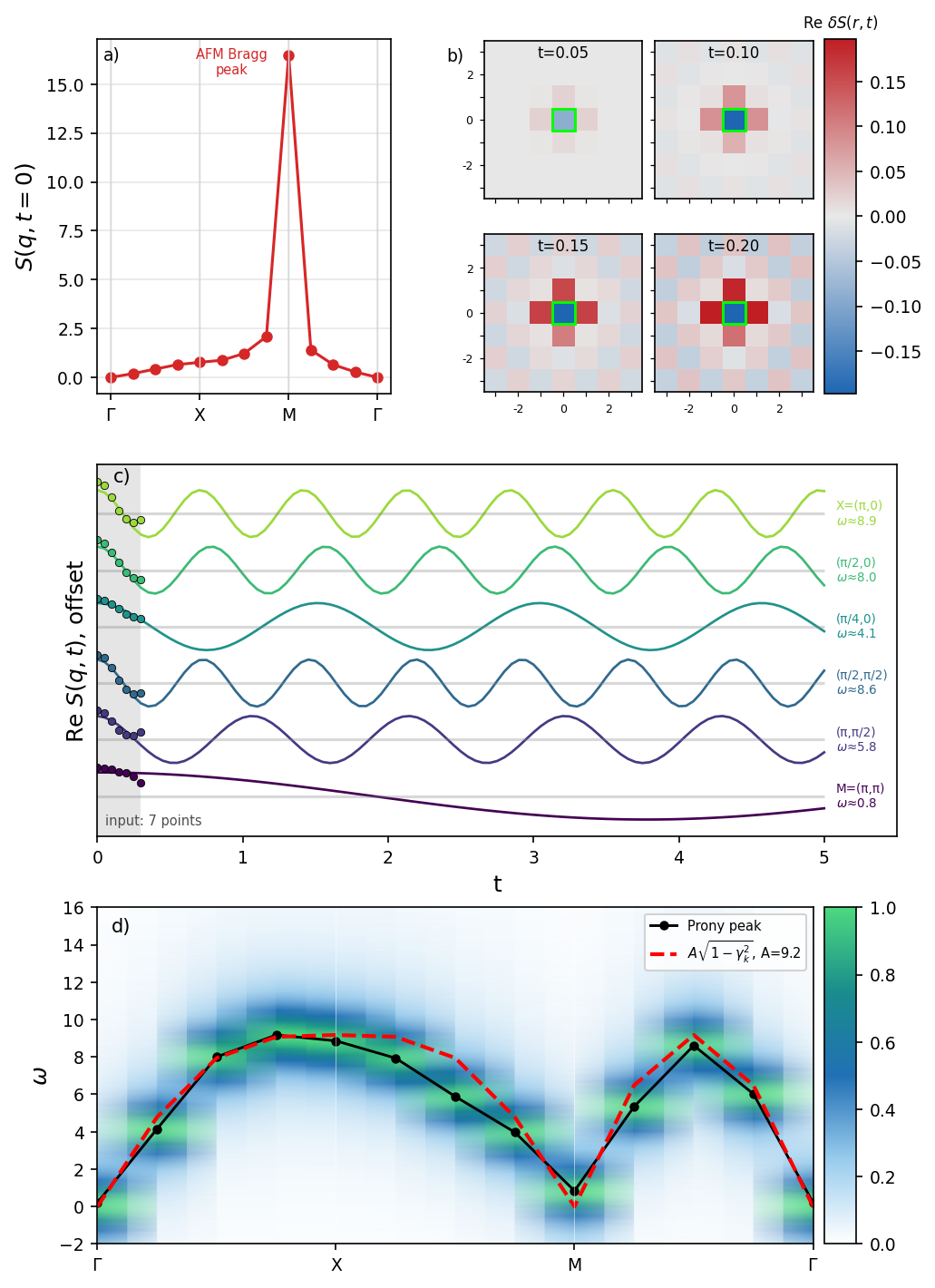
Pauli propagation has shown promise for classically simulating quantum dynamics by evolving observables directly in the Heisenberg picture. In this work, we investigate its use for computing real-time two-point time-ordered correlators in one- and two-dimensional quantum systems. One major limitation of Pauli propagation is the rapid growth in the number of Pauli strings beyond short times. We overcome this limitation by combining accurate short-time Pauli-propagation data with time extension methods based on a positivity condition and the observation that the dynamics are often dominated by a small number of characteristic frequencies. This combined approach extends correlation functions far beyond the directly accessible time window while avoiding the exponential proliferation of Pauli operators. We demonstrate that the resulting correlators retain the relevant dynamical and spectral information. Our results broaden the regime in which classical methods can reliably probe the real-time dynamics of interacting quantum many-body systems.