Abstract
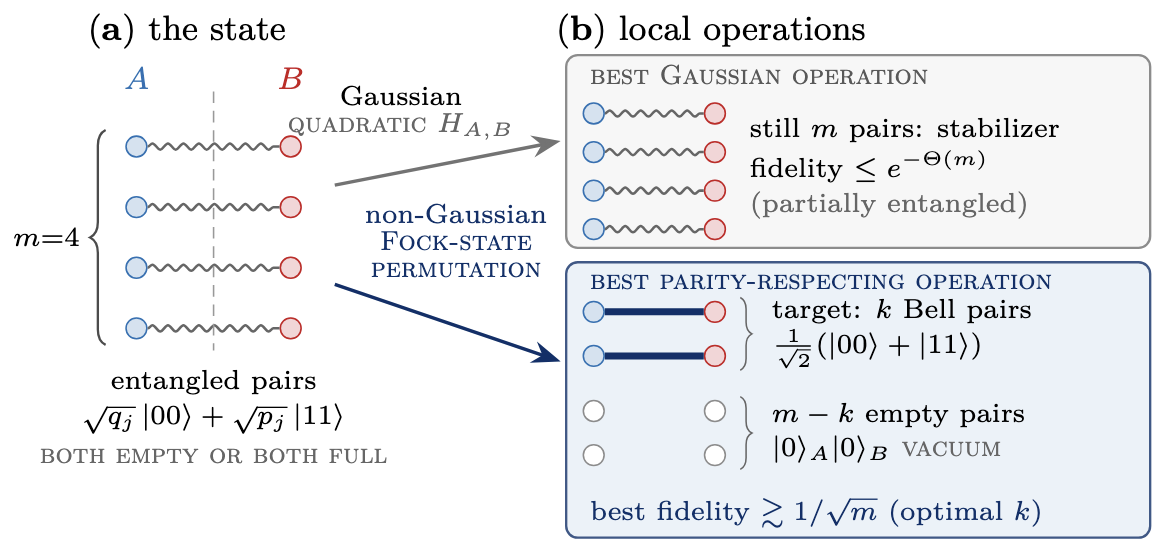
Free-fermion states are classically simulable, yet, written as qubits, they typically carry extensive magic, the quantum resource that stabilizer circuits lack. Part of this magic is nonlocal: local unitaries acting separately on two parts of the system cannot remove it. If these local unitaries are restricted to Gaussian ones, the nonlocal magic grows linearly with the number m of partially entangled fermion pairs. We show that this growth is an artifact of the Gaussian restriction: local Gaussian unitaries minimize the nonlocal stabilizer R'enyi entropy for up to three pairs, but not from four pairs on. General local non-Gaussian unitaries that respect fermion parity take m free-fermion pairs to fermionic Bell pairs with a fidelity that decays at most as 1/sqrt m compared to exponential decay with Gaussian unitaries, so the nonlocal magic drops from linear to logarithmic in m. The reason is statistical — Bell pairs have equal Schmidt weights, that is, a fully degenerate entanglement spectrum, and a state can stay far from them only if its Schmidt weights are spread over many orders of magnitude. This spread is measured by the capacity of entanglement CE, the variance of the entanglement Hamiltonian, and the nonlocal magic of any fermionic state grows at most logarithmically with CE. Free-fermion pairs add to CE independently, so CE grows only linearly in m, and this leads to the stabilizer fidelity decreasing at most as 1/sqrt m. Almost all the magic of free fermions, including Hartree–Fock and BCS mean-field states, is therefore local.