Abstract
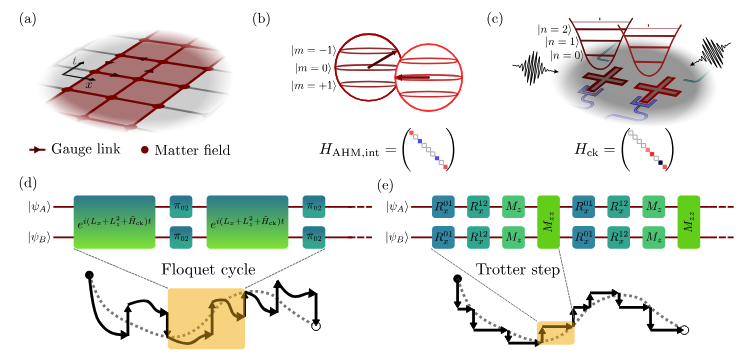
To investigate gauge theories with near-term quantum computers warrants exploration of nontraditional quantum simulators to find resource-efficient simulation protocols and ultimately access exotic features of different field theories, including unexplored regimes of the QCD phase diagram. In this work, using superconducting qutrit processors, we formulated and implemented a pulse-based, three-level, hybrid analog-digital simulation protocol of the (1+1) D Abelian Higgs model (AHM). Alongside this approach, we experimentally realized the gate-based implementation of the same model. Using the natural mapping of the three-level approximated Hamiltonian of a transmon array to the spin-1 truncated AHM, we observe the real time dynamics with both protocols. For the hybrid protocol, we engineer an interaction term in our field theory model via Floquet-based Hamiltonian engineering showing a pathway to realize different non-native interactions in qutrit hardware with designing a pulse sequence with experimentally accessible pulses. This approach potentially enables the realization of various interaction terms associated with different field theories in a resource-efficient manner on near-term qutrit hardware. We observe real time dynamics of the angular momentum observables which are of interest in high-energy physics, including signatures of the string breaking and charge confinement. We present the scalability, resource estimation, and discuss various applications of the implemented protocols. Our experimental schemes provide a viable platform for the future studies of the spin-1 and SU(3) based gauge theory models on near-term qutrit-approximated transmon processors.